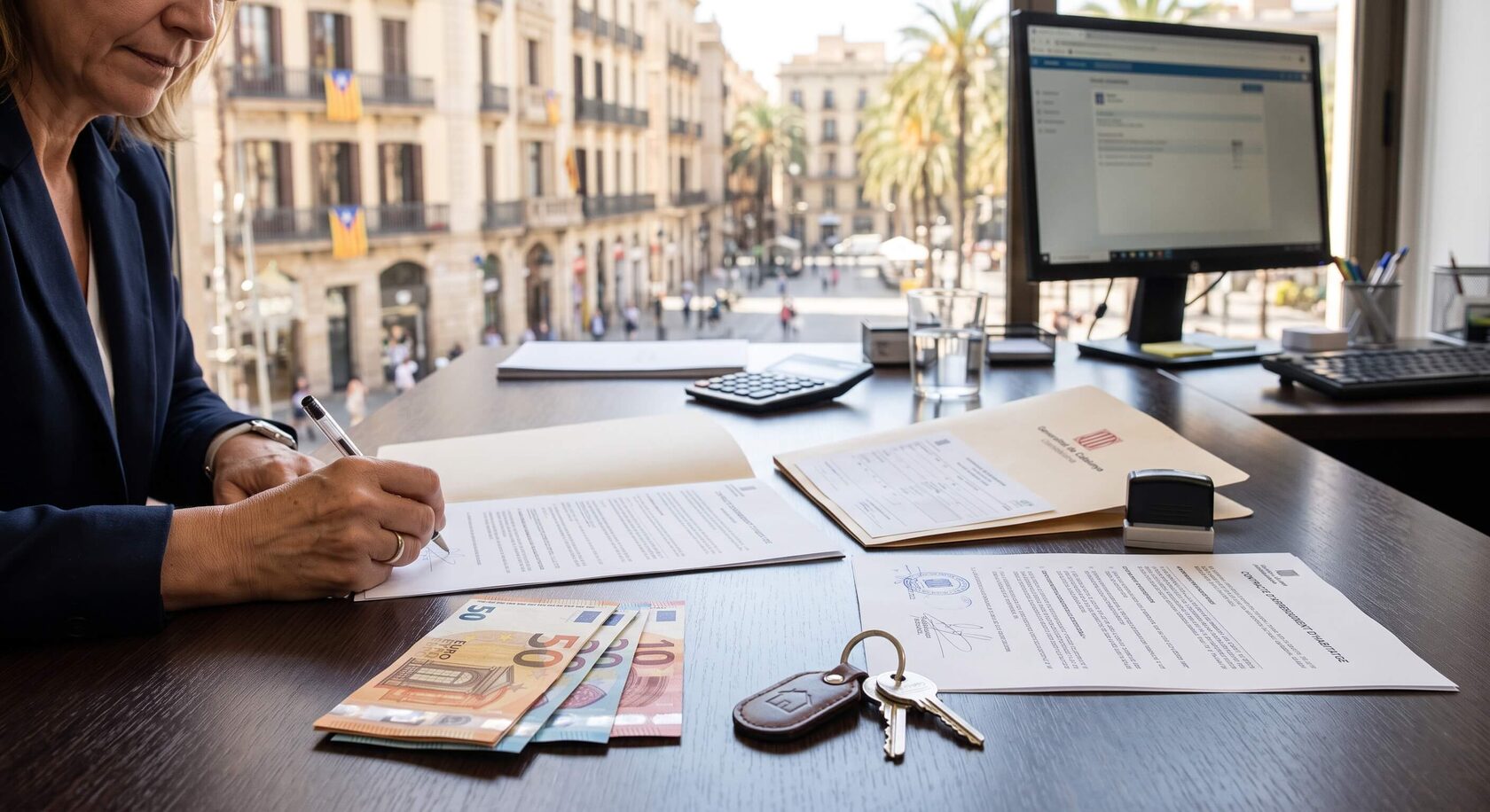
Administering guarantee payments requires strict compliance with the regional legislation of Catalonia. Proper INCASÒL deposits fianza return and the execution of property condition acts protect the landlord from financial losses. Violating the deposit deadlines entails administrative sanctions.
The Spanish real estate market is strictly regulated by civil law norms. The Urban Leases Act establishes rigid frameworks for both parties to the contract. Property owners often underestimate the importance of properly processing guarantee payments. The Catalan state institute controls the turnover of these funds. The deposit procedure is mandatory for all long-term contracts. Ignoring this requirement leads to serious legal consequences.
Catalan legislation in 2026 mandates the digitalization of interactions with state bodies. Paper receipts have completely given way to electronic certificates. The property owner must use the official portal to register the contract. The system automatically records the document's signing date. The countdown for depositing funds begins immediately. Properly executed INCASÒL deposits fianza return make the process transparent and secure.
The Angel Property agency provides comprehensive property management services. Our brokers work daily with state registries. We take on the entire bureaucratic burden. Clients are freed from the need to study the intricacies of regional law. Practical experience allows us to minimize owners' risks. A competent approach to documentation eliminates the possibility of disputing deductions.
Landlord's Obligations for Depositing
The law obliges the property owner to transfer the deposit received from the tenant for safekeeping to a state body. The amount equals one month's rent for residential premises. For commercial properties, the size increases to two months.
According to Article 36 of the LAU (Art. 36), making a guarantee payment is an imperative requirement. The parties cannot cancel this condition by mutual agreement. The Fianza serves as a tool to protect against potential contract breaches. The state uses these accumulated funds to finance social projects. The INCASÒL institute acts as a guarantor of the funds' safety until the contract is terminated.
The registration process requires a digital certificate (Certificado Digital). The landlord fills out the Modelo 2 form on the agency's website. The system generates a payment document with a unique barcode. Payment is made through authorized banking institutions. An alternative option is a direct transfer via the portal's payment gateway. After the funds are credited, an official receipt (Resguardo) is generated.
This document must be provided to the tenant. The absence of a receipt gives the tenant the right to terminate the contract. It also blocks the possibility of obtaining tax deductions. In 2026, the Catalan Tax Agency (ATC) automatically cross-references declaration data with the deposit registry. Discrepancies trigger an immediate tax audit. Therefore, INCASÒL deposits fianza return require utmost accuracy in dates and amounts.
Deadlines for Depositing Funds (2 Months) and the Penalty System
The owner must transfer the money within two months from the contract signing date. A delay entails the automatic accrual of penalties. The size of the sanctions depends on the delay's duration and the fact of prior notification.
The two-month period countdown starts from the date specified in the contract. The actual key handover date does not affect this deadline. If the last day falls on a weekend, the deadline shifts to the next working day. Voluntarily depositing funds after the deadline activates the surcharge system. These Recargos are calculated on a progressive scale.
A delay of up to three months will cost 5% of the deposit amount. From three to six months — 10%. A delay from six to twelve months increases the surcharge to 15%. If a year has passed, 20% is charged plus the standard late payment interest rate. These rules apply only upon voluntary correction of the error.
If an inspection reveals the violation, the situation changes drastically. In this case, a late payment penalty is applied. The administrative punishment ranges from 35% to 75% of the concealed deposit amount. The maximum penalty limit is capped at 3,000 euros for residential real estate. Systematic violations can lead to a ban on renting out the property.
Timeline-graph: Rental Deposit Workflow Cycle
Below is the chronology of the landlord's mandatory actions. The graph reflects the regulatory requirements of 2026.
- Day 0: Signing the rental contract. Receiving funds from the tenant.
- Day 1-15: Preparing the Modelo 2 form. Generating the payment order.
- Day 15-45: Paying the receipt via a bank or online gateway.
- Day 60: CRITICAL DEADLINE. The last day for depositing without sanctions.
- Day 61+: Start of progressive surcharges accrual (Recargos).
- Day X (End of lease): Signing the property handover act.
- Day X+1: Submitting an application for a refund (Modelo 8).
- Day X+21: Standard timeframe for crediting money to the owner's account.
- Day X+30: CRITICAL DEADLINE. The last day to return the balance to the tenant.
- Day X+31+: Accrual of penalties in favor of the tenant for withholding money.
Procedure for Returning and Withholding the Fianza
The refund of funds is initiated by the owner after the contract's termination. The state transfers the money to the landlord's account within 21 days. After this, the owner settles accounts with the former tenant.
The process of withdrawing money requires submitting the Modelo 8 form. The application is submitted exclusively in electronic format. The contract termination agreement is attached to the application. The institute verifies the data and initiates a bank transfer. It is important to understand that the state returns the entire amount to the owner. Disputes regarding damages occur between the contract parties. Properly executed INCASÒL deposits fianza return guarantee the availability of funds for compensation.
Legal withholding of funds is possible only with evidence. The owner has the right to compensate for unpaid utility bills. Damage caused to the property is also covered. Cleaning the premises can be deducted if the property is left in an unsanitary condition. All deductions must be confirmed by official invoices from contractors.
Money cannot be withheld based on rough estimates. If the repair has not yet been completed, an official estimate (presupuesto) must be provided. The remaining amount is transferred to the former tenant's account. A detailed calculation of deductions is attached to the transfer. The transparency of this process eliminates the risk of lawsuits.
Legal Force of Photo Acts (Acta de entrada/salida)
Documentary recording of the property's condition is the main protection tool. Photographs with timestamps prove the fact of property damage. Without these acts, proving the tenant's guilt in court is practically impossible.
The Acta de entrada document is signed on the day the keys are handed over. It contains a detailed inventory of the property. Every scratch on the furniture or appliance defect is recorded in writing. A digital photo report is attached to the act. Photographs must have metadata with the date and geolocation. Both parties sign every page of the document.
Upon contract termination, an Acta de salida is drawn up. This document records the apartment's condition at the time of departure. A joint inspection of the premises is conducted. Identified defects are entered into the act. If the tenant refuses to sign the document, a notary or independent witnesses are involved. Comparing the two acts provides a legal basis for compensation.
Assessing Natural Wear and Tear vs. Damages
The law prohibits fining the tenant for the normal deterioration of the apartment. Natural wear and tear is the owner's responsibility. Damages caused by negligence or malicious intent are paid by the tenant.
The line between wear and damage often becomes a subject of dispute. Scuffs on walls from furniture are considered natural wear. Faded curtains or minor scratches on baseboards are also not subject to compensation. The owner cannot demand payment for cosmetic repairs after five years of renting. Spanish judicial practice unequivocally protects tenants in such cases.
However, a burned sofa is classified as direct damage. Broken mirrors, snapped door hinges, or ruined household appliances require reimbursement. Withholding of funds in these situations is absolutely legal. It is important to consider the depreciation of the damaged item. If a washing machine was ten years old, one cannot demand the cost of a new model. Only the residual value of the item is compensated.
Deadlines for Returning the Deposit to the Tenant (30 Days)
Legislation gives the owner one month to conduct mutual settlements. The period is calculated from the moment the keys are handed over and the act is signed. Violating this deadline gives the tenant the right to demand financial compensation.
The thirty-day period is intended for receiving final electricity and water bills. This time is also given to assess repair costs. The owner must request a refund from the state fund in the first few days. INCASÒL deposits fianza return usually take about three weeks. The remaining time is sufficient to transfer the balance to the tenant.
If utility bills have not yet arrived, withholding an estimated amount is allowed. This amount is calculated based on previous months. After receiving the actual invoices, the final settlement is made. The difference is returned to the former tenant. All communications must be conducted in writing via Burofax or email.
Accrual of Penalties for Late Return
Delaying the payment of the deposit balance entails the accrual of legal interest. The rate is determined annually in the state budget. The owner is obliged to pay the debt along with the accrued interest.
If the owner ignores the demands, the tenant files a lawsuit. The judicial process for small claims (up to 2,000 euros) follows a simplified procedure. The presence of a lawyer is not mandatory. The court will order the owner to return the money. Additionally, a late payment penalty in the form of interest will be imposed.
The interest rate (Interés legal del dinero) in 2026 is approximately 3.25% per annum. The penalty accrues from the 31st day after the keys are handed over. The amount seems insignificant, but legal costs fall on the losing party. Reputational losses for the landlord are also quite tangible. Professional management by Angel Property completely eliminates such risks.
Interacting with INCASÒL When Changing Tenants
The process of replacing tenants requires the correct re-registration of guarantee payments. There are two legal ways to solve this task. The choice of method depends on the signing dates of the new contract.
The first option is a full withdrawal of funds and a new deposit. The owner terminates the old contract. Submits the Modelo 8 form for a refund. Receives the money in their account. Then signs a contract with the new tenant. Fills out the Modelo 2 form and deposits the funds back. This path takes time but guarantees accounting clarity. INCASÒL deposits fianza return in this case go through a full cycle.
The second option is applied when a change of tenant occurs instantly. The law allows re-registering the existing deposit to a new contract. A special data modification form (Modelo 4) is used for this. The owner notifies the agency about the change of contract parties. The deposit amount remains in the institute's accounts.
This method requires matching deposit amounts. If the rent under the new contract is higher, the difference must be paid. An additional receipt is generated for the missing amount. If the rent has decreased, the institute will return the surplus to the owner. A change of tenant through re-registration saves time. However, the procedure requires careful filling out of details. An error in the new tenant's data will lead to problems during a future return.
Frequently Asked Questions
Property management raises many questions for owners. Below are answers to the most frequent inquiries. The information is relevant to the legal framework of Catalonia in 2026.
What happens if the fianza is not deposited in INCASÒL?
Ignoring the obligation to deposit is a serious administrative offense. The Catalan Tax Agency regularly conducts cross-checks. If the fact of concealment is revealed, the owner faces a heavy fine. The sanction size reaches 75% of the deposit amount. Furthermore, the tenant loses the right to regional tax deductions. This gives them a legal basis to sue the landlord. The owner will be obliged to compensate the tenant for lost financial benefits.
Can the deposit be withheld for unpaid utility bills?
Yes, the law explicitly allows using the guarantee payment to cover supply debts. Water, electricity, gas, and internet can be paid from these funds. The owner must provide the tenant with copies of unpaid invoices. The debt amount is deducted from the total refund amount. If the deposit is insufficient to cover all debts, the owner has the right to demand the difference through court. It is important to record meter readings in the handover act upon departure.
How to prove that the tenant broke the furniture?
The only reliable proof is comparing two documents. These are the property acceptance act and the property handover act. Both documents must contain detailed photographs with dates. If the first act records an intact table, and the second a broken one, the tenant's guilt is obvious. Witness testimonies from neighbors or a concierge can also be attached to the case. Without an initial photo report, proving guilt is extremely difficult. The court usually sides with the Arrendatario in the absence of hard evidence.
Is it necessary to deposit an additional guarantee (Garantía adicional)?
No, only the mandatory part of the deposit is subject to state depositing. This is one month for housing and two months for commercial properties. Additional guarantees remain in the owner's account. The 2026 law limits the size of additional guarantees to two months' rent. These funds serve as insurance against serious damage or prolonged non-payment. The owner freely manages this money during the contract period. However, the rules for their return are identical to the rules for returning the main amount.
How to return money from INCASÒL if the tenant is a foreigner?
The refund procedure does not depend on the tenant's citizenship. The owner submits a standard application through the electronic portal. The state transfers the money to the landlord's Spanish account. Difficulties arise at the stage of transferring the balance to the former tenant. If the foreigner closed their account in Spain and left, a transfer to another country may be subject to high bank commissions. By law, these commissions are paid by the recipient of the funds. The owner must keep the bank transfer receipt as proof of fulfilling obligations.
Who pays for repairs in case of natural wear and tear?
Repairs related to the normal use of the dwelling are paid by the landlord. Painting the walls every few years is the owner's responsibility. Replacing worn-out faucet washers or repairing an old boiler also falls on the owner's shoulders. The tenant is only obliged to carry out minor routine repairs. For example, replacing burnt-out light bulbs or cleaning air conditioner filters. An attempt to withhold money for natural wear and tear will lead to a loss in court. INCASÒL deposits fianza return must be carried out honestly and transparently.
