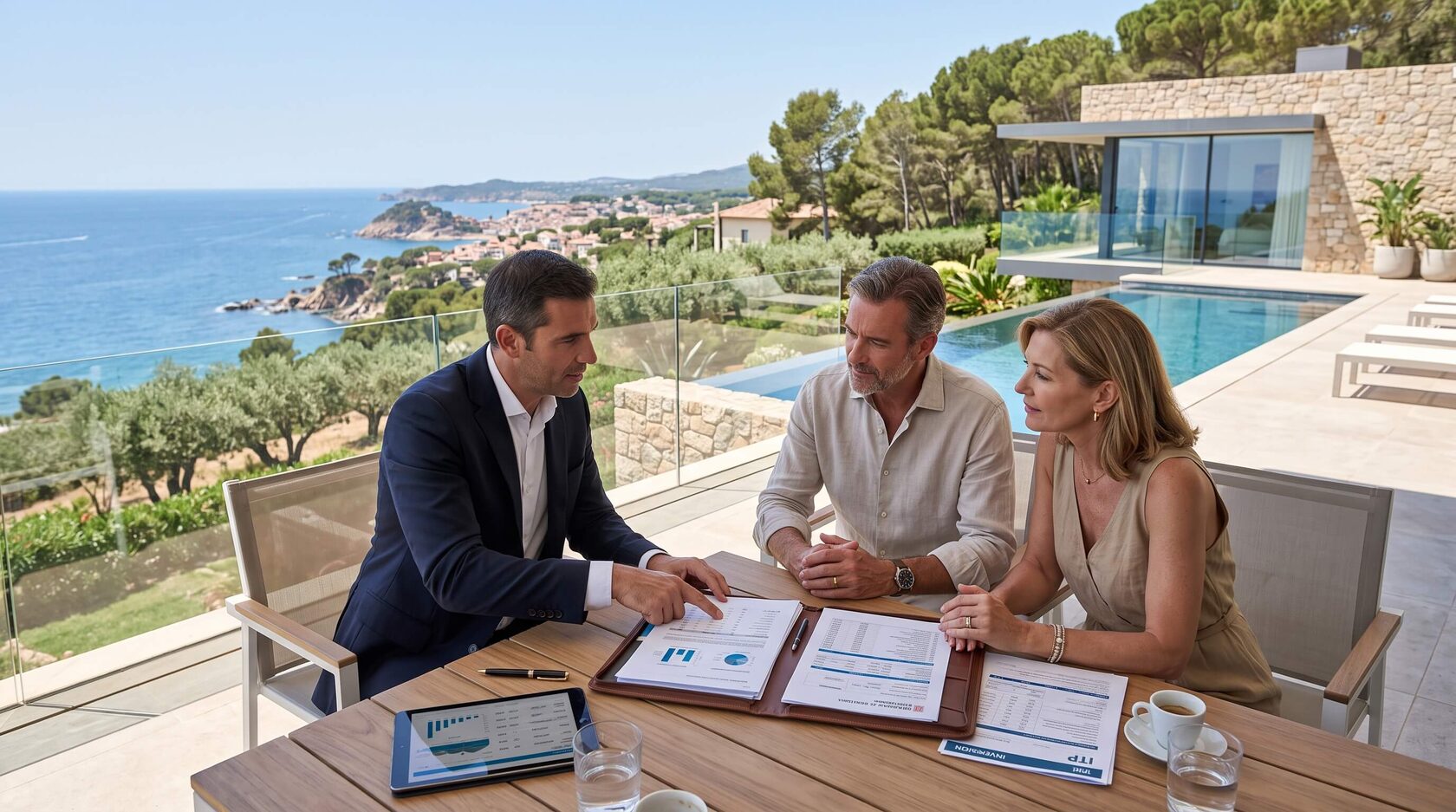
Acquiring premium real estate in Spain requires precise financial planning. The fiscal policy of autonomous communities directly determines the final asset cost for an investor. In 2026, the ITP tax 13% Catalonia applies to transactions involving elite assets. This rate remains one of the highest across the Iberian Peninsula. Understanding the mechanics of this levy is critically important for a correct assessment of investment profitability.
Impuesto de Transmisiones Patrimoniales (ITP) represents a property transfer tax. It is levied exclusively when the transaction involves the secondary market. Primary real estate is subject to different levies. The Catalan government utilizes a progressive scale for ITP calculation. This means the tax burden increases proportionally to the acquired asset's value. Such an approach aims to redistribute the fiscal load. Buyers of luxury residences take the main impact.
Investors frequently underestimate transaction costs during budget planning. A standard error involves applying a flat 10% base rate to the entire transaction amount. However, buying a villa costing over one and a half million euros activates maximum coefficients. The calculation difference can reach tens of thousands of euros. This is exactly why a preliminary asset audit becomes a mandatory stage. The expertise of specialized brokers prevents unforeseen financial losses.
The Angel Property luxury real estate agency specializes in managing complex investment transactions. Our tax consultants work daily with the current 2026 legislation. We analyze every property through the lens of fiscal efficiency. Competent tax optimization begins long before signing the reservation agreement. In this article, we will thoroughly dissect the ITP calculation algorithm. You will receive a comprehensive guide to legally reducing associated expenses.
Impuesto de Transmisiones Patrimoniales (ITP) represents a property transfer tax. It is levied exclusively when the transaction involves the secondary market. Primary real estate is subject to different levies. The Catalan government utilizes a progressive scale for ITP calculation. This means the tax burden increases proportionally to the acquired asset's value. Such an approach aims to redistribute the fiscal load. Buyers of luxury residences take the main impact.
Investors frequently underestimate transaction costs during budget planning. A standard error involves applying a flat 10% base rate to the entire transaction amount. However, buying a villa costing over one and a half million euros activates maximum coefficients. The calculation difference can reach tens of thousands of euros. This is exactly why a preliminary asset audit becomes a mandatory stage. The expertise of specialized brokers prevents unforeseen financial losses.
The Angel Property luxury real estate agency specializes in managing complex investment transactions. Our tax consultants work daily with the current 2026 legislation. We analyze every property through the lens of fiscal efficiency. Competent tax optimization begins long before signing the reservation agreement. In this article, we will thoroughly dissect the ITP calculation algorithm. You will receive a comprehensive guide to legally reducing associated expenses.
Mechanics of the ITP Tranche System in 2026
The tranche system in Catalonia dictates a phased increase in the tax rate from 10% to 13% based on the property's value. This mechanism applies strictly to secondary market real estate.
The 2026 legislative framework strictly regulates the calculation procedure for property taxes. The local government, known as the Generalitat, holds the authority to adjust rates within established corridors. Unlike regions featuring a flat scale, Catalonia implements a principle of social equity through taxation. The baseline 10% rate applies solely to economy and comfort-class properties. Once the value exceeds established limits, multiplying coefficients are triggered.
The system operates on a principle of "tax buckets" or tranches. The total property value is not multiplied by a single maximum percentage. Instead, the amount is fractured into segments. Each segment is placed into its corresponding tranche. A unique rate is applied to each specific tranche. The final tax amount is generated by summing the results across all tranches. This mathematical algorithm demands absolute precision when drafting the transaction budget.
It is crucial to understand that the contract price does not always serve as the calculation base. The tax authority relies on the higher of two specific values. This can be either the actual transaction price or the cadastral reference value. This nuance frequently becomes an unpleasant surprise for foreign buyers. Ignoring this rule leads to financial penalties and supplementary tax assessments.
The 2026 legislative framework strictly regulates the calculation procedure for property taxes. The local government, known as the Generalitat, holds the authority to adjust rates within established corridors. Unlike regions featuring a flat scale, Catalonia implements a principle of social equity through taxation. The baseline 10% rate applies solely to economy and comfort-class properties. Once the value exceeds established limits, multiplying coefficients are triggered.
The system operates on a principle of "tax buckets" or tranches. The total property value is not multiplied by a single maximum percentage. Instead, the amount is fractured into segments. Each segment is placed into its corresponding tranche. A unique rate is applied to each specific tranche. The final tax amount is generated by summing the results across all tranches. This mathematical algorithm demands absolute precision when drafting the transaction budget.
It is crucial to understand that the contract price does not always serve as the calculation base. The tax authority relies on the higher of two specific values. This can be either the actual transaction price or the cadastral reference value. This nuance frequently becomes an unpleasant surprise for foreign buyers. Ignoring this rule leads to financial penalties and supplementary tax assessments.
Difference Between Fixed Rate and Progressive Scale
A fixed rate applies a single percentage to the entire tax base, whereas a progressive scale divides the amount into segments. Each subsequent segment is taxed at a higher rate.
For clarity, let us compare the fiscal models of different Spanish regions. Madrid and Andalusia operate under a fixed ITP rate. It stands at 6% and 7% respectively. If an investor purchases a two-million-euro house in Marbella, they pay exactly 7% of the total sum. The calculation is exceptionally simple and transparent. Transaction costs are easily forecasted at the initial stage.
In Catalonia, the situation is fundamentally different. Here, the ITP tax 13% Catalonia serves as the upper limit of the progressive scale. That same two-million-euro house on the Costa Brava will require a complex multi-step calculation. The first 600 thousand will be taxed at 10%. The next 300 thousand at 11%. The subsequent 600 thousand will fall under 12%. Only the remaining 500 thousand will be calculated at the maximum 13% rate.
This model makes transaction costs variable. The effective tax rate will always be lower than the maximum, yet higher than the minimum. It is calculated individually for every single property. The more expensive the real estate, the closer the effective rate gets to the coveted 13%. This demands the highest qualification from brokers when advising clients. A calculation error can derail the transaction during the notary signing phase.
For clarity, let us compare the fiscal models of different Spanish regions. Madrid and Andalusia operate under a fixed ITP rate. It stands at 6% and 7% respectively. If an investor purchases a two-million-euro house in Marbella, they pay exactly 7% of the total sum. The calculation is exceptionally simple and transparent. Transaction costs are easily forecasted at the initial stage.
In Catalonia, the situation is fundamentally different. Here, the ITP tax 13% Catalonia serves as the upper limit of the progressive scale. That same two-million-euro house on the Costa Brava will require a complex multi-step calculation. The first 600 thousand will be taxed at 10%. The next 300 thousand at 11%. The subsequent 600 thousand will fall under 12%. Only the remaining 500 thousand will be calculated at the maximum 13% rate.
This model makes transaction costs variable. The effective tax rate will always be lower than the maximum, yet higher than the minimum. It is calculated individually for every single property. The more expensive the real estate, the closer the effective rate gets to the coveted 13%. This demands the highest qualification from brokers when advising clients. A calculation error can derail the transaction during the notary signing phase.
Detailed Tax Calculation for Properties > €1.5 Million
Calculating the tax for luxury real estate requires dividing the cadastral or market value into four approved ranges. The final sum is formed by adding the results of each tranche.
To demonstrate the system's operation in practice, Angel Property specialists have prepared a detailed breakdown. Let us examine a classic investment scenario. A client plans to acquire a premium coastal asset. The target property is a modern residence featuring panoramic sea views. The declared value stands at 2,500,000 euros. The asset belongs to the "secondary market" category, having previously had an owner.
Below is a Markdown table. It contains a step-by-step calculation of the tax burden. This calculator is relevant for all transactions registered in Catalonia throughout 2026.
To demonstrate the system's operation in practice, Angel Property specialists have prepared a detailed breakdown. Let us examine a classic investment scenario. A client plans to acquire a premium coastal asset. The target property is a modern residence featuring panoramic sea views. The declared value stands at 2,500,000 euros. The asset belongs to the "secondary market" category, having previously had an owner.
Below is a Markdown table. It contains a step-by-step calculation of the tax burden. This calculator is relevant for all transactions registered in Catalonia throughout 2026.
As evident from the table, the final tax amount equals 295,000 euros. The effective rate stands at 11.8%. If the investor had simply multiplied 2.5 million by 13%, they would have reached 325,000 euros. The 30,000 euro difference demonstrates the importance of a correct mathematical approach. Next, we will thoroughly analyze each level of this fiscal staircase.
Tranche 1: up to €600,000 (10%)
The base rate of 10% applies to the first 600 thousand euros of any property's value. This is the minimum threshold for standard transactions.
The first level of the progressive scale covers the foundation of the asset's value. Regardless of whether an apartment costs 500 thousand or a villa costs 5 million, the first 600,000 euros are always taxed at 10%. In our example with the 2.5 million residence, we take exactly 600 thousand and multiply it by 0.10. We get 60,000 euros. This is the baseline fiscal load.
This tranche was established by the government to protect middle-segment homebuyers. For a long time, the 10% rate was uniform across all of Catalonia. However, budget deficits forced authorities to revise their approach. Now, 10% is merely the starting point. For investors in the elite sector, this tranche provides a small but tangible saving compared to a flat high rate.
The first level of the progressive scale covers the foundation of the asset's value. Regardless of whether an apartment costs 500 thousand or a villa costs 5 million, the first 600,000 euros are always taxed at 10%. In our example with the 2.5 million residence, we take exactly 600 thousand and multiply it by 0.10. We get 60,000 euros. This is the baseline fiscal load.
This tranche was established by the government to protect middle-segment homebuyers. For a long time, the 10% rate was uniform across all of Catalonia. However, budget deficits forced authorities to revise their approach. Now, 10% is merely the starting point. For investors in the elite sector, this tranche provides a small but tangible saving compared to a flat high rate.
Tranche 2: €600,000 - €900,000 (11%)
The amount exceeding 600 thousand but not reaching 900 thousand euros is taxed at an 11% rate. This tranche covers the business-class segment.
The second step of the scale activates as soon as the price crosses the 600,000 euro mark. The capacity of this tranche is exactly 300,000 euros (from 600k to 900k). In our case study, the villa's value significantly exceeds this limit. Consequently, we completely fill this tranche. We take 300,000 euros and apply the 11% rate to them. The result equals 33,000 euros.
This range frequently becomes critical for buyers of business-class real estate in Barcelona. Apartments in the Eixample or Sarrià-Sant Gervasi districts often fall precisely into this price bracket. A 1% rate increase seems insignificant. However, in absolute numbers, it adds thousands of euros to the purchase budget. Investors must account for this jump when negotiating with the seller.
The second step of the scale activates as soon as the price crosses the 600,000 euro mark. The capacity of this tranche is exactly 300,000 euros (from 600k to 900k). In our case study, the villa's value significantly exceeds this limit. Consequently, we completely fill this tranche. We take 300,000 euros and apply the 11% rate to them. The result equals 33,000 euros.
This range frequently becomes critical for buyers of business-class real estate in Barcelona. Apartments in the Eixample or Sarrià-Sant Gervasi districts often fall precisely into this price bracket. A 1% rate increase seems insignificant. However, in absolute numbers, it adds thousands of euros to the purchase budget. Investors must account for this jump when negotiating with the seller.
Tranche 3: €900,000 - €1,500,000 (12%)
The third level of the progressive scale establishes a 12% rate for capital between 900 thousand and 1.5 million euros. Here begins the premium real estate zone.
The third tranche possesses a capacity of 600,000 euros. It covers the difference between 900 thousand and one and a half million. Our 2.5 million villa easily breaks through this ceiling as well. Therefore, we take the maximum tranche capacity (600,000 euros) and multiply it by 12%. The resulting tax amount at this stage equals 72,000 euros.
It is exactly at this level that buying a villa begins to generate serious fiscal obligations. The 12% rate significantly exceeds average indicators across the European Union. Catalan authorities justify this by the necessity to finance social programs. For a foreign investor, this means only one thing: the market entry cost rises. A thorough analysis of the asset's liquidity is required before making a decision.
The third tranche possesses a capacity of 600,000 euros. It covers the difference between 900 thousand and one and a half million. Our 2.5 million villa easily breaks through this ceiling as well. Therefore, we take the maximum tranche capacity (600,000 euros) and multiply it by 12%. The resulting tax amount at this stage equals 72,000 euros.
It is exactly at this level that buying a villa begins to generate serious fiscal obligations. The 12% rate significantly exceeds average indicators across the European Union. Catalan authorities justify this by the necessity to finance social programs. For a foreign investor, this means only one thing: the market entry cost rises. A thorough analysis of the asset's liquidity is required before making a decision.
Tranche 4: over €1,500,000 (13%)
The maximum 13% rate applies exclusively to amounts exceeding the 1.5 million euro threshold. This is a targeted wealth tax.
The fourth and final tranche has no upper limit. Any amount exceeding 1,500,000 euros lands here. In our example, the total value is 2.5 million. We subtract 1.5 million (already distributed across previous tranches). Exactly 1,000,000 euros remain. The maximum ITP tax 13% Catalonia is applied to this million. The calculation result is 130,000 euros.
This tranche is the primary generator of tax revenues from luxury real estate transactions. It was introduced as a direct tax on wealth. Investors acquiring assets worth 5 or 10 million euros contribute colossal sums to the autonomy's budget. This is exactly where professional tax optimization demonstrates its maximum efficiency. Reducing the tax base even by a few hundred thousand euros yields massive savings.
The fourth and final tranche has no upper limit. Any amount exceeding 1,500,000 euros lands here. In our example, the total value is 2.5 million. We subtract 1.5 million (already distributed across previous tranches). Exactly 1,000,000 euros remain. The maximum ITP tax 13% Catalonia is applied to this million. The calculation result is 130,000 euros.
This tranche is the primary generator of tax revenues from luxury real estate transactions. It was introduced as a direct tax on wealth. Investors acquiring assets worth 5 or 10 million euros contribute colossal sums to the autonomy's budget. This is exactly where professional tax optimization demonstrates its maximum efficiency. Reducing the tax base even by a few hundred thousand euros yields massive savings.
Legal Strategies for Optimizing Transaction Costs
Optimizing the tax burden requires structuring the transaction through corporate mechanisms or dividing ownership rights. A competent approach allows for a legal reduction of the effective rate.
Reducing the fiscal burden is a priority task for wealthy clients. Spanish legislation strictly punishes tax evasion. However, a clear boundary exists between illegal evasion and legal optimization. Utilizing legally permitted instruments allows for a substantial reduction in costs. Angel Property experts possess extensive experience in implementing such strategies.
Let us examine a real case from our agency's practice. In the first quarter of 2026, the Angel Property tax department managed a transaction on the Costa Brava. The client planned to purchase a historical estate for 3.2 million euros. The initial calculation showed a colossal ITP amount. The effective rate approached 12.3%. Our team conducted a deep audit of the property and identified an opportunity for legal maneuvering.
The first step involved analyzing the cadastral documentation. We discovered that a significant portion of the asset's value was formed by an extensive plot of agricultural land. The residential structure itself was valued much more modestly. We initiated an asset separation procedure. The residential portion was registered to a natural person. The agricultural lands were acquired by a specially created legal entity (Sociedad Limitada).
Purchasing the land through a company allowed the application of an entirely different tax regime. Instead of the progressive ITP scale, the land transaction proceeded using other fiscal mechanisms available for agricultural business. The residential portion, whose value dropped below the critical 1.5 million euro mark, avoided falling into the fourth tranche (13%).
The outcome of this complex legal operation was a saving of over 85,000 euros for our client. The tax optimization was conducted in strict compliance with the norms of the tax authority (Agencia Tributaria). This case proves that buying a villa of premium class requires unconventional solutions. A straightforward approach always leads to maximum overpayments.
Another effective strategy involves challenging the reference value. State algorithms frequently overvalue elite properties. They fail to account for specific flaws: utility wear, terrain features, or legal encumbrances. Conducting an independent architectural appraisal before executing the transaction allows for a reasoned reduction of the tax base. This is a complex process requiring the participation of licensed appraisers and lawyers.
Reducing the fiscal burden is a priority task for wealthy clients. Spanish legislation strictly punishes tax evasion. However, a clear boundary exists between illegal evasion and legal optimization. Utilizing legally permitted instruments allows for a substantial reduction in costs. Angel Property experts possess extensive experience in implementing such strategies.
Let us examine a real case from our agency's practice. In the first quarter of 2026, the Angel Property tax department managed a transaction on the Costa Brava. The client planned to purchase a historical estate for 3.2 million euros. The initial calculation showed a colossal ITP amount. The effective rate approached 12.3%. Our team conducted a deep audit of the property and identified an opportunity for legal maneuvering.
The first step involved analyzing the cadastral documentation. We discovered that a significant portion of the asset's value was formed by an extensive plot of agricultural land. The residential structure itself was valued much more modestly. We initiated an asset separation procedure. The residential portion was registered to a natural person. The agricultural lands were acquired by a specially created legal entity (Sociedad Limitada).
Purchasing the land through a company allowed the application of an entirely different tax regime. Instead of the progressive ITP scale, the land transaction proceeded using other fiscal mechanisms available for agricultural business. The residential portion, whose value dropped below the critical 1.5 million euro mark, avoided falling into the fourth tranche (13%).
The outcome of this complex legal operation was a saving of over 85,000 euros for our client. The tax optimization was conducted in strict compliance with the norms of the tax authority (Agencia Tributaria). This case proves that buying a villa of premium class requires unconventional solutions. A straightforward approach always leads to maximum overpayments.
Another effective strategy involves challenging the reference value. State algorithms frequently overvalue elite properties. They fail to account for specific flaws: utility wear, terrain features, or legal encumbrances. Conducting an independent architectural appraisal before executing the transaction allows for a reasoned reduction of the tax base. This is a complex process requiring the participation of licensed appraisers and lawyers.
Frequently Asked Questions
How Does Valor de Referencia Affect the ITP Base?
The cadastral reference value determines the minimum tax base. If the contract price is lower than this value, the tax is calculated from the reference value.
The Valor de Referencia metric, introduced a few years ago, radically changed the rules of the game. Previously, the tax was calculated from the amount stated in the deed. Now, the state establishes its own minimum. The reference value is updated annually based on Cadastre data. It is formed based on average transaction prices in a specific area.
If you buy a villa for 2 million euros, but its reference value is 2.5 million, the tax will be calculated from 2.5 million. This is called the Base Liquidable (taxable base). If the transaction price is higher than the reference value, the tax is paid on the actual price. The state always selects the larger of the two sums. It is possible to challenge the Valor de Referencia, but the burden of proof lies with the taxpayer. An official appraisal and an appeal filing will be required.
The Valor de Referencia metric, introduced a few years ago, radically changed the rules of the game. Previously, the tax was calculated from the amount stated in the deed. Now, the state establishes its own minimum. The reference value is updated annually based on Cadastre data. It is formed based on average transaction prices in a specific area.
If you buy a villa for 2 million euros, but its reference value is 2.5 million, the tax will be calculated from 2.5 million. This is called the Base Liquidable (taxable base). If the transaction price is higher than the reference value, the tax is paid on the actual price. The state always selects the larger of the two sums. It is possible to challenge the Valor de Referencia, but the burden of proof lies with the taxpayer. An official appraisal and an appeal filing will be required.
Can ITP Be Reduced by Purchasing Through a Legal Entity?
Purchasing through a company can change the tax type from ITP to IVA. This is advantageous under specific conditions of conducting commercial activity.
Acquiring real estate through a Spanish company (SL) grants access to the Inversión del Sujeto Pasivo mechanism. If both the seller and the buyer are legal entities and VAT payers, the transaction can be processed through IVA (VAT) rather than ITP. In this scenario, the VAT can be offset. Actual tax payment into the budget is not executed.
However, this scheme only works for commercial real estate or plots intended for development. If a company buys a ready-to-move-in home on the secondary market for the founder's residence, the ITP tax 13% Catalonia will still be applied. The tax service strictly monitors fictitious corporate structures. Using a company exclusively to own a personal villa can lead to supplementary tax assessments and penalties.
Acquiring real estate through a Spanish company (SL) grants access to the Inversión del Sujeto Pasivo mechanism. If both the seller and the buyer are legal entities and VAT payers, the transaction can be processed through IVA (VAT) rather than ITP. In this scenario, the VAT can be offset. Actual tax payment into the budget is not executed.
However, this scheme only works for commercial real estate or plots intended for development. If a company buys a ready-to-move-in home on the secondary market for the founder's residence, the ITP tax 13% Catalonia will still be applied. The tax service strictly monitors fictitious corporate structures. Using a company exclusively to own a personal villa can lead to supplementary tax assessments and penalties.
Is ITP Paid When Buying New Build Properties?
No, primary real estate is subject to Value Added Tax (IVA) and stamp duty (AJD). ITP applies exclusively to the secondary market.
The separation of tax regimes depends on the property's status. If you buy a villa directly from a developer (first transfer of rights), you pay IVA. In 2026, the VAT rate for new housing stands at 10%. This rate is fixed and does not depend on the property's value. A 5 million euro villa from a developer will incur a 10% VAT.
In addition to VAT, purchasing a new build requires the payment of the tax on documented legal acts — AJD (Actos Jurídicos Documentados). In Catalonia, the base AJD rate is 1.5%. Thus, the total tax burden on the primary market equals 11.5%. This makes buying new elite properties mathematically more profitable than acquiring similar villas on the secondary market, where the effective ITP rate can reach 12-12.5%.
The separation of tax regimes depends on the property's status. If you buy a villa directly from a developer (first transfer of rights), you pay IVA. In 2026, the VAT rate for new housing stands at 10%. This rate is fixed and does not depend on the property's value. A 5 million euro villa from a developer will incur a 10% VAT.
In addition to VAT, purchasing a new build requires the payment of the tax on documented legal acts — AJD (Actos Jurídicos Documentados). In Catalonia, the base AJD rate is 1.5%. Thus, the total tax burden on the primary market equals 11.5%. This makes buying new elite properties mathematically more profitable than acquiring similar villas on the secondary market, where the effective ITP rate can reach 12-12.5%.
How Is the Tax Distributed When Buying in Shares?
Each co-owner pays the tax proportionally to their share. The progressive scale is applied to the total property value, not to individual shares.
A frequent investor misconception involves attempting to bypass the progressive scale through ownership fragmentation. Clients assume that if they buy a 2 million euro villa for four family members, each share will be 500 thousand. Consequently, each would only pay 10% (the first tranche). This is fundamentally incorrect.
The Catalan tax authority calculates ITP based on 100% of the property's value. First, the total tax amount for the 2 million euro villa is determined using all tranches. Then, this final sum is divided proportionally to the ownership shares. If the tax amounted to 230,000 euros, each of the four owners will pay exactly one quarter of this sum. Bypassing the ITP tax 13% Catalonia through this method is impossible.
A frequent investor misconception involves attempting to bypass the progressive scale through ownership fragmentation. Clients assume that if they buy a 2 million euro villa for four family members, each share will be 500 thousand. Consequently, each would only pay 10% (the first tranche). This is fundamentally incorrect.
The Catalan tax authority calculates ITP based on 100% of the property's value. First, the total tax amount for the 2 million euro villa is determined using all tranches. Then, this final sum is divided proportionally to the ownership shares. If the tax amounted to 230,000 euros, each of the four owners will pay exactly one quarter of this sum. Bypassing the ITP tax 13% Catalonia through this method is impossible.
Does Non-Resident Status Affect the ITP Rate?
The buyer's tax residency does not affect the ITP rate. The progressive scale is uniform for both residents and foreign investors.
Spanish legislation does not discriminate against buyers based on citizenship or residency when calculating transaction taxes. A Spanish citizen and an investor from third countries will pay the exact same ITP amount when purchasing an identical property. The Generalitat's rules are universal for all real estate market participants.
However, non-resident status matters for other fiscal obligations. Specifically, foreign owners of luxury real estate annually pay the Impuesto sobre el Patrimonio (wealth tax) if the value of their net assets in Spain exceeds the established tax-free minimum. Furthermore, non-residents pay an imputed income tax (IRNR), even if the property is not leased. These factors must be considered when calculating the total cost of asset ownership.
Spanish legislation does not discriminate against buyers based on citizenship or residency when calculating transaction taxes. A Spanish citizen and an investor from third countries will pay the exact same ITP amount when purchasing an identical property. The Generalitat's rules are universal for all real estate market participants.
However, non-resident status matters for other fiscal obligations. Specifically, foreign owners of luxury real estate annually pay the Impuesto sobre el Patrimonio (wealth tax) if the value of their net assets in Spain exceeds the established tax-free minimum. Furthermore, non-residents pay an imputed income tax (IRNR), even if the property is not leased. These factors must be considered when calculating the total cost of asset ownership.
What Are the Deadlines for Paying the Tax After Signing the Deed?
The law allocates exactly 30 working days for ITP payment. The countdown begins the moment the notarial deed of sale is signed.
The transaction execution procedure is strictly regulated by time. As soon as the Notario (notary) certifies the purchase agreement (Escritura Pública), the timer starts. The buyer has one calendar month (or 30 working days, depending on local authority interpretation) to complete the Modelo 600 form and transfer funds to the autonomy's budget.
Missing this deadline triggers the automatic accrual of penalties (recargos). In the first month of delay, the penalty is 1%, and it increases with each subsequent month. Furthermore, without confirmation of ITP payment, it is impossible to register ownership rights in the Registro de la Propiedad. The property will remain in a suspended legal state. Angel Property specialists assume full control over compliance with these deadlines, guaranteeing the flawless purity and security of every transaction.
The transaction execution procedure is strictly regulated by time. As soon as the Notario (notary) certifies the purchase agreement (Escritura Pública), the timer starts. The buyer has one calendar month (or 30 working days, depending on local authority interpretation) to complete the Modelo 600 form and transfer funds to the autonomy's budget.
Missing this deadline triggers the automatic accrual of penalties (recargos). In the first month of delay, the penalty is 1%, and it increases with each subsequent month. Furthermore, without confirmation of ITP payment, it is impossible to register ownership rights in the Registro de la Propiedad. The property will remain in a suspended legal state. Angel Property specialists assume full control over compliance with these deadlines, guaranteeing the flawless purity and security of every transaction.
