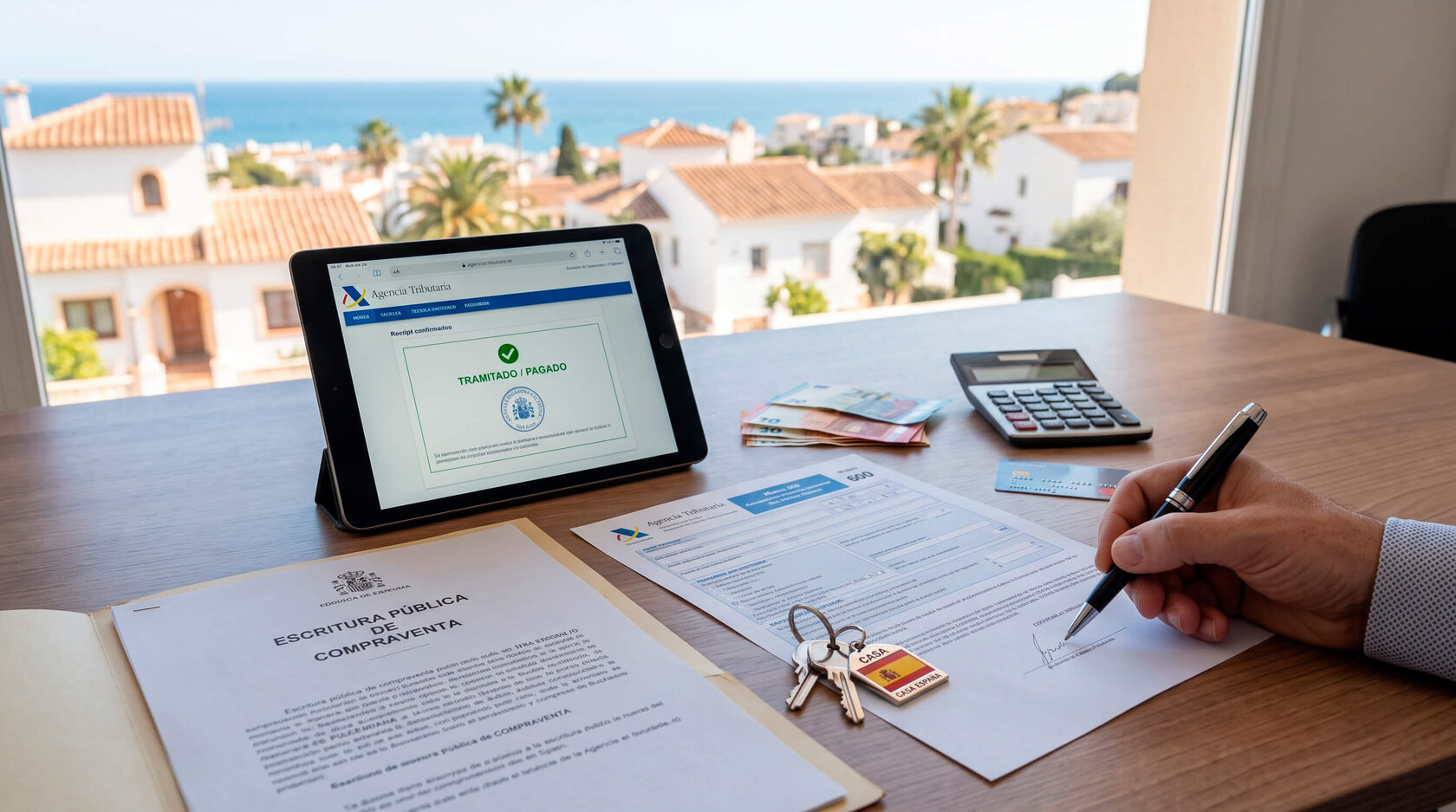
Taxes when buying property in Spain 2026 require strict liquidation within exactly 30 business days from the moment of signing the public deed of sale. Violating this rigid deadline entails the automatic accrual of severe fiscal penalties and a complete, unconditional blockade of the property right registration process within the state registries.
The fiscal system of the Kingdom of Spain is characterized by a high degree of bureaucratization and an uncompromising control over the observance of procedural deadlines. In 2026, the Spanish tax authorities (Agencia Tributaria) successfully completed the transition to a fully automated system of algorithmic cross-checks. This technological shift means that all transactional data from notaries flows into the fiscal authorities' databases in real-time via a unified electronic platform known as the Índice Único Notarial. Consequently, the buyer no longer has the physical or legal opportunity to cite postal delays, lost documents, or administrative misunderstandings as an excuse for late payment.
The complex process of acquiring a real estate asset does not conclude at the moment of handing over the keys and signing the contract. The legal transfer of ownership is considered fully and legitimately completed only after the corresponding entry is made in the state registry. However, the state registrar does not have the legal authority to accept documents for processing if they lack the official stamp or digital cryptographic code from the tax service confirming the full payment of the corresponding duties. Thus, Taxes when buying property in Spain 2026 act not merely as a standard financial obligation, but as the fundamental procedural barrier on the path to legitimate, unencumbered asset ownership.
Depending on the specific type of real estate object (primary developer market or secondary resale market), the buyer faces entirely different fiscal obligations. For new build properties, this involves the Value Added Tax (IVA) set at a flat rate of 10%, alongside the Stamp Duty or Tax on Documented Legal Acts (AJD), the rate of which fluctuates between 1.5% and 2% depending on the specific autonomous community's legislation. For secondary market objects, the Property Transfer Tax (ITP) is applied. The ITP rate in Catalonia, for instance, stands at 10% for properties valued up to 1,000,000 euros and escalates to 11% for any amount exceeding this threshold. Regardless of the specific tax type, the procedural algorithm, the bureaucratic requirements, and the strict deadlines for payment remain absolutely identical across the board.
The fiscal system of the Kingdom of Spain is characterized by a high degree of bureaucratization and an uncompromising control over the observance of procedural deadlines. In 2026, the Spanish tax authorities (Agencia Tributaria) successfully completed the transition to a fully automated system of algorithmic cross-checks. This technological shift means that all transactional data from notaries flows into the fiscal authorities' databases in real-time via a unified electronic platform known as the Índice Único Notarial. Consequently, the buyer no longer has the physical or legal opportunity to cite postal delays, lost documents, or administrative misunderstandings as an excuse for late payment.
The complex process of acquiring a real estate asset does not conclude at the moment of handing over the keys and signing the contract. The legal transfer of ownership is considered fully and legitimately completed only after the corresponding entry is made in the state registry. However, the state registrar does not have the legal authority to accept documents for processing if they lack the official stamp or digital cryptographic code from the tax service confirming the full payment of the corresponding duties. Thus, Taxes when buying property in Spain 2026 act not merely as a standard financial obligation, but as the fundamental procedural barrier on the path to legitimate, unencumbered asset ownership.
Depending on the specific type of real estate object (primary developer market or secondary resale market), the buyer faces entirely different fiscal obligations. For new build properties, this involves the Value Added Tax (IVA) set at a flat rate of 10%, alongside the Stamp Duty or Tax on Documented Legal Acts (AJD), the rate of which fluctuates between 1.5% and 2% depending on the specific autonomous community's legislation. For secondary market objects, the Property Transfer Tax (ITP) is applied. The ITP rate in Catalonia, for instance, stands at 10% for properties valued up to 1,000,000 euros and escalates to 11% for any amount exceeding this threshold. Regardless of the specific tax type, the procedural algorithm, the bureaucratic requirements, and the strict deadlines for payment remain absolutely identical across the board.
The 30-Day Rule: Critical Deadlines After the Notary
Spanish legislation establishes a strict, non-negotiable limit of 30 business days to liquidate all tax obligations after executing the transaction. The countdown officially begins on the day immediately following the notary visit and the signing of the public deed.
The 30-day rule is strictly regulated by the General Tax Law of Spain (Ley General Tributaria) and specific regional normative acts governing ITP and AJD. It is critically important to understand the precise legal interpretation of the term "business days" (días hábiles) within the Spanish legal framework. In Spanish law enforcement practice, Saturdays, Sundays, as well as national and regional public holidays are strictly excluded from the calculation. However, local municipal holidays where the property is located might not coincide with the holidays of the municipality where the tax payment is being processed. To avoid any legal collisions or miscalculations, real estate lawyers strongly recommend basing the timeline on the official calendar of the autonomous community rather than local municipal calendars.
The property purchasing process begins long before the actual visit to the notary office. The very first step is the signing of the Arras (earnest money or deposit contract). At this preliminary stage, the buyer transfers a reservation sum to the seller, which typically amounts to 10% of the total agreed property value. It is crucial to note that upon signing the Arras contract, no property transfer taxes are paid. Fiscal obligations arise exclusively at the exact moment the private contract is elevated to the status of a public document (Escritura Pública).
As soon as the Notario certifies the transaction with their official signature and state seal, the fiscal timer is immediately activated. The notary is legally obligated to send an electronic notification to the property registry on that exact same day to block the object from potential fraudulent activities, such as a double sale or the sudden imposition of an embargo by creditors. This electronic notification creates what is known as a preliminary presentation entry (Asiento de Presentación), which remains valid for exactly 60 calendar days. Within this specific 60-day window, the buyer must manage to pay the Taxes when buying property in Spain 2026 and submit the original physical or authorized digital documents for final registration.
If the buyer misses the 30-day tax payment deadline, they automatically jeopardize the 60-day validity period of the preliminary registry entry, because without the official payment receipt, the registry will categorically refuse to accept the documents. This scenario creates a highly dangerous legal vacuum: the property has been paid for, the funds have been transferred to the seller, but legally, before third parties and the state, the buyer is not yet the full rightful owner. During this vacuum, the asset becomes highly vulnerable to sudden seizures or liens for the previous owner's outstanding debts.
The 30-day rule is strictly regulated by the General Tax Law of Spain (Ley General Tributaria) and specific regional normative acts governing ITP and AJD. It is critically important to understand the precise legal interpretation of the term "business days" (días hábiles) within the Spanish legal framework. In Spanish law enforcement practice, Saturdays, Sundays, as well as national and regional public holidays are strictly excluded from the calculation. However, local municipal holidays where the property is located might not coincide with the holidays of the municipality where the tax payment is being processed. To avoid any legal collisions or miscalculations, real estate lawyers strongly recommend basing the timeline on the official calendar of the autonomous community rather than local municipal calendars.
The property purchasing process begins long before the actual visit to the notary office. The very first step is the signing of the Arras (earnest money or deposit contract). At this preliminary stage, the buyer transfers a reservation sum to the seller, which typically amounts to 10% of the total agreed property value. It is crucial to note that upon signing the Arras contract, no property transfer taxes are paid. Fiscal obligations arise exclusively at the exact moment the private contract is elevated to the status of a public document (Escritura Pública).
As soon as the Notario certifies the transaction with their official signature and state seal, the fiscal timer is immediately activated. The notary is legally obligated to send an electronic notification to the property registry on that exact same day to block the object from potential fraudulent activities, such as a double sale or the sudden imposition of an embargo by creditors. This electronic notification creates what is known as a preliminary presentation entry (Asiento de Presentación), which remains valid for exactly 60 calendar days. Within this specific 60-day window, the buyer must manage to pay the Taxes when buying property in Spain 2026 and submit the original physical or authorized digital documents for final registration.
If the buyer misses the 30-day tax payment deadline, they automatically jeopardize the 60-day validity period of the preliminary registry entry, because without the official payment receipt, the registry will categorically refuse to accept the documents. This scenario creates a highly dangerous legal vacuum: the property has been paid for, the funds have been transferred to the seller, but legally, before third parties and the state, the buyer is not yet the full rightful owner. During this vacuum, the asset becomes highly vulnerable to sudden seizures or liens for the previous owner's outstanding debts.
Step-by-Step Algorithm: From the Tax Office to the Property Registry
The transaction legalization process includes four distinct stages: contract signing, notarization, duty payment, and final registration. Strict adherence to this chronology eliminates legal risks and prevents severe financial losses.
To ensure absolute transparency and a clear understanding of the bureaucratic burden involved, the legal experts at Angel Property agency have developed a highly detailed action algorithm. This comprehensive table demonstrates the ideal, risk-free scenario for navigating all state institutions.
To ensure absolute transparency and a clear understanding of the bureaucratic burden involved, the legal experts at Angel Property agency have developed a highly detailed action algorithm. This comprehensive table demonstrates the ideal, risk-free scenario for navigating all state institutions.
In our daily legal practice in 2026, we are observing a sharp increase in rejections from the tax authorities due to critical errors in filling out the Modelo 600 form. The primary issue is the widespread ignorance of the new cadastral reference value (Valor de Referencia de Catastro). Buyers frequently declare the actual transaction price in the tax form, which may sometimes be lower than the official cadastral valuation. The automated tax system instantly blocks such declarations, demanding the payment of the tax based on the higher amount. If you fail to correct the tax base within the strict 30-day window, you will be hit with an automatic penalty. We always conduct a comprehensive preliminary audit of the Valor de Referencia long before signing the deposit contract, ensuring the client knows their exact fiscal obligations without any unpleasant surprises.
The payment procedure demands utmost concentration and precision. Form 600 is the universal state document for declaring property transfer taxes. Within this form, it is mandatory to correctly input the personal data of the seller and the buyer, the exact cadastral number of the property, the precise square footage, and to apply the correct tax rate. This includes accounting for any potential regional tax reliefs, such as reduced rates for large families, individuals with disabilities, or young buyers under 32 years of age, provided such benefits are stipulated by the specific regional legislation of the autonomous community.
After the declaration is successfully generated, a payment document is created. The payment can be executed in cash (strictly within the legally established limits to prevent money laundering) or via direct debit from an account in an authorized collaborating bank (Entidad Colaboradora). Upon successful transaction, the bank issues a receipt containing a unique NRC code (Número de Referencia Completo). This 22-character cryptographic code serves as the absolute, undeniable proof that the Taxes when buying property in Spain 2026 have been paid in full. Without this specific NRC code, the registry will instantly reject the documents, halting the entire registration process.
After the declaration is successfully generated, a payment document is created. The payment can be executed in cash (strictly within the legally established limits to prevent money laundering) or via direct debit from an account in an authorized collaborating bank (Entidad Colaboradora). Upon successful transaction, the bank issues a receipt containing a unique NRC code (Número de Referencia Completo). This 22-character cryptographic code serves as the absolute, undeniable proof that the Taxes when buying property in Spain 2026 have been paid in full. Without this specific NRC code, the registry will instantly reject the documents, halting the entire registration process.
The Role of the Gestoría: Who Bears Responsibility for Errors?
A gestoría acts as a specialized administrative intermediary between the buyer, the bank, and state authorities. In mortgage transactions, utilizing a bank's designated gestoría is a mandatory, non-negotiable condition for loan issuance.
A Gestoría is a highly specialized Spanish administrative bureau that assumes the entirety of the bureaucratic routine: from physically obtaining the original deeds at the notary's office to standing in queues at the tax agency and the property registry. If the real estate transaction is executed entirely using the buyer's own personal funds, hiring a gestoría remains a voluntary decision. However, if mortgage financing is involved, the lending bank will, in an absolute and dictatorial manner, appoint its own trusted gestoría to handle the paperwork.
The fundamental reason for this banking dictate lies in the protection of the financial institution's core interests. The bank issues a substantial loan secured by the real estate asset. If the buyer were to handle the paperwork independently, forgot to pay the taxes, or missed the strict deadlines, the Registro de la Propiedad would categorically refuse to register the mortgage charge against the property. As a direct result, the bank would be left holding a massive, unsecured loan. To completely eliminate this severe financial risk, the bank mandates the notary execution of the transaction and the subsequent registration to be handled exclusively by their vetted professionals.
The mechanics of working with a gestoría are based on a foundational financial document called the Provisión de Fondos (provision of funds or preliminary cost estimate). Several days prior to the actual transaction, the buyer is legally obligated to transfer a specific sum to the gestoría's special escrow account. This sum must cover all anticipated expenses: property taxes, the notary's honorarium, registry duties, and the gestoría's own service fees. Typically, this estimated sum is calculated with a 10-15% safety margin to account for any unforeseen bureaucratic discrepancies.
Who bears the legal responsibility if the gestoría makes a critical error? According to Spanish tax law, the taxpayer (Sujeto Pasivo) is always the buyer. It is exclusively in the buyer's name that the tax authority will issue any fines or penalties. However, a formal service contract exists between the buyer and the gestoría. If the gestoría negligently misses the 30-day deadline, and the tax authority consequently levies Recargos, the buyer has the absolute legal right to demand full financial compensation for these losses from the agency. All licensed gestorías operating in Spain are legally required to maintain a comprehensive civil liability insurance policy (Seguro de Responsabilidad Civil), which specifically covers such professional negligence incidents.
Once the Taxes when buying property in Spain 2026 are fully paid and the property is officially registered, the gestoría is obligated to provide the client with a final, detailed financial report (Liquidación) and refund any unspent balance from the initial Provisión de Fondos. This final report must be accompanied by the original physical invoices: from the notary, from the registrar, and a certified copy of the paid tax declaration bearing the NRC code.
A Gestoría is a highly specialized Spanish administrative bureau that assumes the entirety of the bureaucratic routine: from physically obtaining the original deeds at the notary's office to standing in queues at the tax agency and the property registry. If the real estate transaction is executed entirely using the buyer's own personal funds, hiring a gestoría remains a voluntary decision. However, if mortgage financing is involved, the lending bank will, in an absolute and dictatorial manner, appoint its own trusted gestoría to handle the paperwork.
The fundamental reason for this banking dictate lies in the protection of the financial institution's core interests. The bank issues a substantial loan secured by the real estate asset. If the buyer were to handle the paperwork independently, forgot to pay the taxes, or missed the strict deadlines, the Registro de la Propiedad would categorically refuse to register the mortgage charge against the property. As a direct result, the bank would be left holding a massive, unsecured loan. To completely eliminate this severe financial risk, the bank mandates the notary execution of the transaction and the subsequent registration to be handled exclusively by their vetted professionals.
The mechanics of working with a gestoría are based on a foundational financial document called the Provisión de Fondos (provision of funds or preliminary cost estimate). Several days prior to the actual transaction, the buyer is legally obligated to transfer a specific sum to the gestoría's special escrow account. This sum must cover all anticipated expenses: property taxes, the notary's honorarium, registry duties, and the gestoría's own service fees. Typically, this estimated sum is calculated with a 10-15% safety margin to account for any unforeseen bureaucratic discrepancies.
Who bears the legal responsibility if the gestoría makes a critical error? According to Spanish tax law, the taxpayer (Sujeto Pasivo) is always the buyer. It is exclusively in the buyer's name that the tax authority will issue any fines or penalties. However, a formal service contract exists between the buyer and the gestoría. If the gestoría negligently misses the 30-day deadline, and the tax authority consequently levies Recargos, the buyer has the absolute legal right to demand full financial compensation for these losses from the agency. All licensed gestorías operating in Spain are legally required to maintain a comprehensive civil liability insurance policy (Seguro de Responsabilidad Civil), which specifically covers such professional negligence incidents.
Once the Taxes when buying property in Spain 2026 are fully paid and the property is officially registered, the gestoría is obligated to provide the client with a final, detailed financial report (Liquidación) and refund any unspent balance from the initial Provisión de Fondos. This final report must be accompanied by the original physical invoices: from the notary, from the registrar, and a certified copy of the paid tax declaration bearing the NRC code.
Penalty Sanctions (Recargos) for Late Payments
Late tax payments are penalized by a progressive scale of surcharges ranging from 1% to 15%, plus default interest. The exact sanction size depends entirely on the delay duration and the fact of voluntary debt acknowledgment.
The Spanish tax system is notoriously unforgiving of forgetfulness or administrative delays. If the strict 30-day deadline has expired and the payment has not been registered in the system, Article 27 of the General Tax Law (Ley 58/2003, de 17 de diciembre, General Tributaria) immediately comes into effect. This specific article regulates the surcharges for late filing without a prior formal demand from the tax administration (Recargos por declaración extemporánea sin requerimiento previo).
In 2026, the following progressive scale of penalty sanctions is strictly enforced:
A critically important nuance: if the delay is less than 12 months, the tax authority does not charge default interest (intereses de demora). However, the moment the delay exceeds one full year, default interest is added to the 15% surcharge for every single day of delay, starting from the 366th day. In 2026, the base rate for default interest (interés de demora) is legally set at approximately 4.0625% per annum.
Let us examine a precise mathematical example. You purchased a secondary market apartment in Barcelona for 500,000 euros. The ITP tax (at a 10% rate) amounts to 50,000 euros. You completely forgot to pay it and only remembered 6 months later.
If, however, the tax service discovers the non-payment first and sends you an official, formal demand letter (Requerimiento), the situation deteriorates drastically. In this scenario, standard Recargos are no longer applied; instead, you face full-fledged tax penalties Spain (Sanciones Tributarias). These punitive fines can range from 50% to a staggering 150% of the total debt amount, depending entirely on the classified severity of the offense (minor, serious, very serious) and the proven presence of malicious intent to conceal financial information.
Furthermore, unpaid taxes completely paralyze the work of the property registry. The registrar will issue a formal decision to suspend the registration process (Defecto subsanable). If the defect is not rectified (i.e., the tax is not paid) within the allotted timeframe—usually 60 days—the preliminary presentation entry is permanently canceled. The property will legally remain registered in the seller's name, which immediately opens the door for the imposition of asset seizures or embargoes for the previous owner's outstanding debts. Therefore, timely payment is not merely a matter of saving money on fines; it is a matter of fundamental, uncompromising security for your real estate investments.
The Spanish tax system is notoriously unforgiving of forgetfulness or administrative delays. If the strict 30-day deadline has expired and the payment has not been registered in the system, Article 27 of the General Tax Law (Ley 58/2003, de 17 de diciembre, General Tributaria) immediately comes into effect. This specific article regulates the surcharges for late filing without a prior formal demand from the tax administration (Recargos por declaración extemporánea sin requerimiento previo).
In 2026, the following progressive scale of penalty sanctions is strictly enforced:
- Delay of up to 1 month: The surcharge is a flat 1% of the unpaid tax amount.
- Delay from 1 to 12 months: To the base 1%, an additional 1% is added for every full month of delay. For example, if you are exactly 5 months late, the total surcharge will be 5%.
- Delay exceeding 12 months: A fixed, severe surcharge of 15% is applied.
A critically important nuance: if the delay is less than 12 months, the tax authority does not charge default interest (intereses de demora). However, the moment the delay exceeds one full year, default interest is added to the 15% surcharge for every single day of delay, starting from the 366th day. In 2026, the base rate for default interest (interés de demora) is legally set at approximately 4.0625% per annum.
Let us examine a precise mathematical example. You purchased a secondary market apartment in Barcelona for 500,000 euros. The ITP tax (at a 10% rate) amounts to 50,000 euros. You completely forgot to pay it and only remembered 6 months later.
- Original Tax Amount: 50,000 euros.
- Surcharge (6 months = 6%): 3,000 euros.
- Total Amount Due: 53,000 euros.
If, however, the tax service discovers the non-payment first and sends you an official, formal demand letter (Requerimiento), the situation deteriorates drastically. In this scenario, standard Recargos are no longer applied; instead, you face full-fledged tax penalties Spain (Sanciones Tributarias). These punitive fines can range from 50% to a staggering 150% of the total debt amount, depending entirely on the classified severity of the offense (minor, serious, very serious) and the proven presence of malicious intent to conceal financial information.
Furthermore, unpaid taxes completely paralyze the work of the property registry. The registrar will issue a formal decision to suspend the registration process (Defecto subsanable). If the defect is not rectified (i.e., the tax is not paid) within the allotted timeframe—usually 60 days—the preliminary presentation entry is permanently canceled. The property will legally remain registered in the seller's name, which immediately opens the door for the imposition of asset seizures or embargoes for the previous owner's outstanding debts. Therefore, timely payment is not merely a matter of saving money on fines; it is a matter of fundamental, uncompromising security for your real estate investments.
Frequently Asked Questions
This section compiles the most critical technical aspects of interacting with fiscal authorities and state registries. The answers are strictly based on current 2026 law enforcement practice and the rigid regulations of Spanish government institutions.
Can taxes be paid from abroad?
Yes, payment is possible via bank transfer to the tax authority's account using an NRC code. This requires a digital signature or a trusted representative in Spain.
Paying taxes as a non-resident from foreign bank accounts is fraught with severe technical difficulties. The Spanish tax system is deeply integrated exclusively with local collaborating banks (Entidades Colaboradoras). A direct international wire transfer from a bank outside of Spain (even within the European SEPA zone) does not automatically generate the mandatory NRC code required to confirm the payment to the registry.
In 2026, the most optimal and secure solution for non-residents is to open a fully functional account in a Spanish bank well before executing the transaction. If this is logistically impossible, the buyer must execute a notarized Power of Attorney (Poder Notarial) granting representation rights to a lawyer or gestoría in Spain. The trusted representative receives the funds into their secure client account and executes the payment on behalf of the buyer, successfully generating the necessary NRC code. It is also technically possible to use specialized payment gateways of the tax service if the buyer possesses a Spanish electronic signature certificate (Certificado Digital) or is registered in the Cl@ve system; however, a linked account in a partner bank is still strictly required for the actual fund debit.
Paying taxes as a non-resident from foreign bank accounts is fraught with severe technical difficulties. The Spanish tax system is deeply integrated exclusively with local collaborating banks (Entidades Colaboradoras). A direct international wire transfer from a bank outside of Spain (even within the European SEPA zone) does not automatically generate the mandatory NRC code required to confirm the payment to the registry.
In 2026, the most optimal and secure solution for non-residents is to open a fully functional account in a Spanish bank well before executing the transaction. If this is logistically impossible, the buyer must execute a notarized Power of Attorney (Poder Notarial) granting representation rights to a lawyer or gestoría in Spain. The trusted representative receives the funds into their secure client account and executes the payment on behalf of the buyer, successfully generating the necessary NRC code. It is also technically possible to use specialized payment gateways of the tax service if the buyer possesses a Spanish electronic signature certificate (Certificado Digital) or is registered in the Cl@ve system; however, a linked account in a partner bank is still strictly required for the actual fund debit.
What to do if the registry returns documents with an error?
You must request a qualification note from the registrar specifying the refusal reason and rectify the defect within 60 days. Usually, a corrective notarial deed is required.
The rigorous process of document verification by the registrar is legally termed Calificación Registral. The registrar possesses absolute, unquestionable independence in their decision-making process. If they discover any contradictions in the deed (for example, a discrepancy between the stated square footage and the cadastral data, the absence of a mandatory energy efficiency certificate, errors in describing the plot boundaries, or the lack of a tax payment receipt), they will immediately suspend the registration.
Errors are legally categorized into curable defects (Defectos subsanables) and incurable defects (Defectos insubsanables). In 95% of practical cases, the errors are curable. The buyer or their appointed gestoría must return to the notary who originally executed the transaction. The Notario then drafts a supplementary legal document (Acta de Subsanación), in which they formally correct the typo or attach the missing documentation. This corrective act is then resubmitted to the Registro de la Propiedad. During the time taken to correct the error, the validity period of the preliminary entry (Asiento de Presentación) is legally extended, fully protecting the buyer's rights.
The rigorous process of document verification by the registrar is legally termed Calificación Registral. The registrar possesses absolute, unquestionable independence in their decision-making process. If they discover any contradictions in the deed (for example, a discrepancy between the stated square footage and the cadastral data, the absence of a mandatory energy efficiency certificate, errors in describing the plot boundaries, or the lack of a tax payment receipt), they will immediately suspend the registration.
Errors are legally categorized into curable defects (Defectos subsanables) and incurable defects (Defectos insubsanables). In 95% of practical cases, the errors are curable. The buyer or their appointed gestoría must return to the notary who originally executed the transaction. The Notario then drafts a supplementary legal document (Acta de Subsanación), in which they formally correct the typo or attach the missing documentation. This corrective act is then resubmitted to the Registro de la Propiedad. During the time taken to correct the error, the validity period of the preliminary entry (Asiento de Presentación) is legally extended, fully protecting the buyer's rights.
What commissions does a notary charge in 2026?
The notary fee is strictly regulated by the state and depends on the property value, deed length, and copy count. The average amount ranges from 600 to 1200 euros.
In Spain, notaries are highly qualified public officials, even though they operate their offices as independent professionals. They absolutely do not have the legal right to set arbitrary prices for their services. The tariffs (Aranceles) are strictly approved by Royal Decree and are uniformly applied across the entire national territory.
The base rate depends directly on the property price declared in the contract. For instance, for a property valued at 100,000 euros, the base tariff will be approximately 390 euros, while for a property valued at 500,000 euros, it will be around 650 euros. To this base figure, several additional mandatory costs are added: the cost of official stamped paper (Papel Timbrado), the number of issued authorized and simple copies (Copias Autorizadas y Simples), electronic inquiries to the registry and cadastre, as well as the Value Added Tax (IVA) at a rate of 21% applied to the notary's services. It is important to note that if the transaction includes a mortgage, two entirely separate deeds are executed (one for the purchase and one for the credit), which effectively doubles the notarial workload; however, under the LCCI law, the bank is legally obligated to pay the expenses for the mortgage deed.
In Spain, notaries are highly qualified public officials, even though they operate their offices as independent professionals. They absolutely do not have the legal right to set arbitrary prices for their services. The tariffs (Aranceles) are strictly approved by Royal Decree and are uniformly applied across the entire national territory.
The base rate depends directly on the property price declared in the contract. For instance, for a property valued at 100,000 euros, the base tariff will be approximately 390 euros, while for a property valued at 500,000 euros, it will be around 650 euros. To this base figure, several additional mandatory costs are added: the cost of official stamped paper (Papel Timbrado), the number of issued authorized and simple copies (Copias Autorizadas y Simples), electronic inquiries to the registry and cadastre, as well as the Value Added Tax (IVA) at a rate of 21% applied to the notary's services. It is important to note that if the transaction includes a mortgage, two entirely separate deeds are executed (one for the purchase and one for the credit), which effectively doubles the notarial workload; however, under the LCCI law, the bank is legally obligated to pay the expenses for the mortgage deed.
How much does registration in the Registro de la Propiedad cost?
Registrar services are also tariffed according to a strict state scale, typically costing between 400 and 800 euros. The amount is calculated based on the property's registered value.
Just as with notaries, the honorariums of property registrars (Aranceles Registrales) are strictly regulated by national law. They are calculated using a regressive scale based on the declared value of the real estate. The more expensive the property, the lower the percentage rate of the tariff, but the higher the final absolute sum.
The legal property registration deadlines dictate that the process must be completed within 15 business days from the moment the full, correct package of documents (the deed and the tax payment confirmation) is submitted. If the registrar delays the issuance of the documents without a valid, legally justified reason, the tariff can be forcibly reduced by 30% as a penalty sanction against the registry. Upon successful completion of the procedure, the buyer receives the original physical deed bearing the official registration stamp and a freshly issued extract (Nota Simple), which serves as the ultimate confirmation of their status as the full, unencumbered owner.
Just as with notaries, the honorariums of property registrars (Aranceles Registrales) are strictly regulated by national law. They are calculated using a regressive scale based on the declared value of the real estate. The more expensive the property, the lower the percentage rate of the tariff, but the higher the final absolute sum.
The legal property registration deadlines dictate that the process must be completed within 15 business days from the moment the full, correct package of documents (the deed and the tax payment confirmation) is submitted. If the registrar delays the issuance of the documents without a valid, legally justified reason, the tariff can be forcibly reduced by 30% as a penalty sanction against the registry. Upon successful completion of the procedure, the buyer receives the original physical deed bearing the official registration stamp and a freshly issued extract (Nota Simple), which serves as the ultimate confirmation of their status as the full, unencumbered owner.
Do I need to change Catastro data myself?
In 2026, notaries automatically send ownership change data to the Cadastre via an index system. However, buyers are strongly advised to verify the update after 2-3 months.
The Cadastre (Catastro) is an administrative registry maintained by the Ministry of Finance, which contains the physical, economic, and legal characteristics of all real estate. Unlike the Property Registry, which confirms the legal right of ownership, the Cadastre serves primarily as the foundational database for calculating and levying the annual municipal real estate tax (IBI).
Thanks to deep state digitalization, the Notario is legally obligated to send an electronic notification regarding the change of title to the General Directorate of the Cadastre within a few days after signing the deed. The procedure for changing the owner's name (Alteración de Titularidad) generally occurs in the background without buyer intervention. Nevertheless, bureaucratic glitches and system failures do occur. If, after six months, the old owner is still listed in the cadastral database, the annual IBI tax bill will be incorrectly sent to their name. In such a scenario, the new buyer will be forced to manually submit the Modelo 900D form via the Cadastre's electronic headquarters (Sede Electrónica del Catastro), attaching a certified digital copy of the deed as proof.
The Cadastre (Catastro) is an administrative registry maintained by the Ministry of Finance, which contains the physical, economic, and legal characteristics of all real estate. Unlike the Property Registry, which confirms the legal right of ownership, the Cadastre serves primarily as the foundational database for calculating and levying the annual municipal real estate tax (IBI).
Thanks to deep state digitalization, the Notario is legally obligated to send an electronic notification regarding the change of title to the General Directorate of the Cadastre within a few days after signing the deed. The procedure for changing the owner's name (Alteración de Titularidad) generally occurs in the background without buyer intervention. Nevertheless, bureaucratic glitches and system failures do occur. If, after six months, the old owner is still listed in the cadastral database, the annual IBI tax bill will be incorrectly sent to their name. In such a scenario, the new buyer will be forced to manually submit the Modelo 900D form via the Cadastre's electronic headquarters (Sede Electrónica del Catastro), attaching a certified digital copy of the deed as proof.
How to get receipts for Modelo 600 payment at the bank?
Payment receipts are generated automatically when filling out the tax form on the tax authority's portal. With the printed document, you can visit any partner bank.
The process of Modelo 600 payment in 2026 is maximally standardized and digitized. The taxpayer or their legal representative logs onto the official website of the tax administration of the respective autonomous community (for example, the Agència Tributària de Catalunya). Within a specialized software interface (Programa de Ayuda), all fields of the declaration are meticulously filled out. The system automatically calculates the exact tax amount based on the inputted data and the applicable regional rate.
After successful data validation, the system generates a secure PDF document consisting of several distinct pages (a copy for the tax authority, a copy for the payer, and a copy for the bank). A unique barcode and a specific document number (Número de Justificante) are printed on the document. Armed with this physical printout, the buyer goes to the teller of any major Spanish collaborating bank (such as Santander, BBVA, CaixaBank, etc.). The bank teller scans the barcode, accepts the cash (or debits the linked account), and issues a formal receipt containing the critical NRC code. This receipt is then securely attached to the tax authority's copy of the declaration and submitted alongside the original deed to the property registry.
The process of Modelo 600 payment in 2026 is maximally standardized and digitized. The taxpayer or their legal representative logs onto the official website of the tax administration of the respective autonomous community (for example, the Agència Tributària de Catalunya). Within a specialized software interface (Programa de Ayuda), all fields of the declaration are meticulously filled out. The system automatically calculates the exact tax amount based on the inputted data and the applicable regional rate.
After successful data validation, the system generates a secure PDF document consisting of several distinct pages (a copy for the tax authority, a copy for the payer, and a copy for the bank). A unique barcode and a specific document number (Número de Justificante) are printed on the document. Armed with this physical printout, the buyer goes to the teller of any major Spanish collaborating bank (such as Santander, BBVA, CaixaBank, etc.). The bank teller scans the barcode, accepts the cash (or debits the linked account), and issues a formal receipt containing the critical NRC code. This receipt is then securely attached to the tax authority's copy of the declaration and submitted alongside the original deed to the property registry.
Summarizing the complex bureaucratic landscape, it can be stated with absolute certainty that Taxes when buying property in Spain 2026 do not tolerate an amateurish or negligent approach. The state bureaucratic mechanism operates with the precision of a Swiss watch, and any delay at the critical stage of transitioning from the Arras contract to the final registration inevitably leads to severe financial losses in the form of Recargos and profound legal complications within the Registro de la Propiedad. Navigating all state institutions independently is technically possible, but it requires a deep, professional understanding of fiscal legislation and absolute fluency in legal Spanish.
To guarantee the absolute security of your investments, completely avoid state fines, and save invaluable time, entrust the bureaucratic routine to licensed professionals. The legal department of Angel Property agency will ensure the flawless execution of all transaction stages: from the preliminary audit of the cadastral value to obtaining the final, unencumbered extract from the registry. Order full legal support for your transaction right now, and we will take full, uncompromising responsibility for every single document and every strict deadline.
To guarantee the absolute security of your investments, completely avoid state fines, and save invaluable time, entrust the bureaucratic routine to licensed professionals. The legal department of Angel Property agency will ensure the flawless execution of all transaction stages: from the preliminary audit of the cadastral value to obtaining the final, unencumbered extract from the registry. Order full legal support for your transaction right now, and we will take full, uncompromising responsibility for every single document and every strict deadline.
